UV Printing vs Screen Printing: The Real Cost Difference
The same 100 golf tees: one supplier quotes $9.99, another quotes $79. Eight times apart. A third says it depends on how many colors you need.
Nobody is lying. The price gap almost never comes from ink quality or machine speed. It comes from where the cost sits: screen printing charges you up front, UV charges you on every single piece.
Everything that follows — why a small batch looks expensive one way and cheap the other, why one extra color is nearly free on one process and expensive on the other — grows out of that one structural difference.
The Short Answer
Your situationThe cheaper optionUp to 1,000 piecesUVThree or more colors, up to 3,000 piecesUVPhotos, gradients, fine detailUVOne color, from about 1,100 piecesScreen printing5,000 pieces or more, any number of colorsScreen printingA full wrap (360°)Screen printing (UV cannot)Reordering the same artworkScreen printingEvery piece must be differentUV
If you remember only one line: the more colors you have, the larger the quantity screen printing needs before it wins. The three price cards below show why.
How the price moves at 100, 1,000 and 5,000 pieces
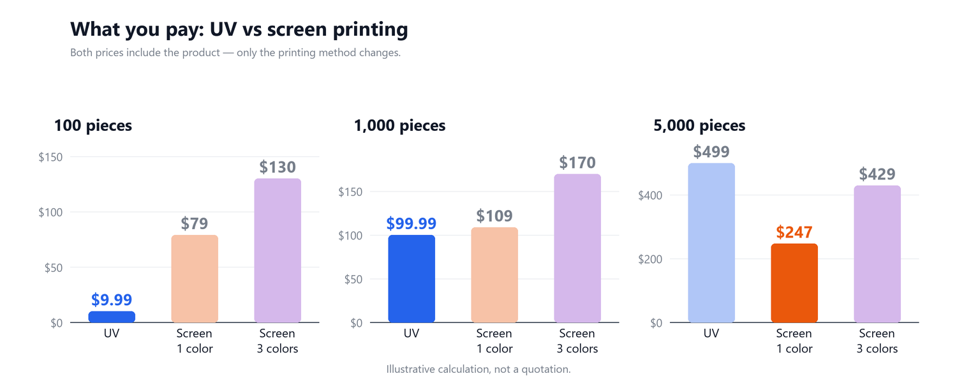
100, 1,000 and 5,000 pieces: UV vs screen printing price comparison
Three price cards, one set of prices, only the quantity changes.
100 pieces: UV $9.99, one-color screen printing $79, three-color screen printing $130. UV is eight times cheaper.
1,000 pieces: UV $99.99, one-color screen printing $109, three-color screen printing $170. UV still wins, but by only 9%.
5,000 pieces: UV $499, one-color screen printing $247, three-color screen printing $429. Screen printing takes the lead — half the price on one color.
Put the three side by side and you get a complete curve: UV is a straight line at $0.10 a piece, while screen printing first stands on a $79 minimum charge, then drives its unit price down with volume.
One more thing worth noticing: from 100 to 500 pieces, one-color screen printing is quoted at the same $79. That is not a stable unit price — that is a minimum charge, a fixed fee that has nothing to do with quantity. This is precisely why a small order can never beat UV.
Both sets of prices include the product itself; the only thing being compared is the price difference the printing method creates. All figures are calculated values and do not constitute a quotation.
How UV printing is priced
UV is a digital process. A printhead lays ink onto the surface and a UV lamp cures it immediately, so there is no drying time, no film and no screen. The start-up cost is one file plus one test print.
That means almost every cent is a variable cost: ink, machine time, labour, packing. Double the quantity and the total roughly doubles; the unit price barely moves.
This brings a few things:
- Small runs are normal. 50 pieces is a normal order, not a favour.
- Color is almost free. A four-color logo costs about the same as a one-color logo; the file is rasterised only once.
- Photos and gradients are possible, because the logic is essentially the same as a desktop printer.
- Changes are cheap. Change the file, print again. No need to remake the film.
- Variable data is possible. Each piece can carry a different name, number or QR code.
The trade-off: the unit price never comes down. UV loses on large volumes not because it gets worse, but because screen printing gets better.
There is also a geometric limit. UV needs the printhead to "see" the surface, so on small or curved items the printable area is only a narrow band — on a golf tee, just a few millimetres wide. A tall, narrow logo must either be scaled down or the process changed.
How screen printing is priced
Screen printing is an analog process. The artwork is first separated by color, output as film, and the film is used to expose a screen. One color, one film, one screen. A squeegee then pushes ink through the mesh — one pass per color, with drying or curing between passes.
This start-up cost is real work, and it is charged only once:
- Film output, per color
- Screen making, per color
- Registration and make-ready, per color
- Test prints until the color is right
So a screen printing quote starts from "a number", not from zero.
And that "number" is often packaged as a minimum charge: 100 pieces quoted at $79, 500 pieces still at $79. It is not a unit price; it is a fixed fee unrelated to quantity — it gets you to the starting line, and volume-based pricing only begins from 1,000 pieces.
The unit cost, however, is low. Ink is cheap and the machine is fast, so one pass costs only a fraction of UV. The total then becomes a line with a high intercept and a low slope — the larger the volume, the better that line looks.
Three conclusions:
- Color count is the main lever. A three-color job needs three films, three screens and three registration passes. One more color raises the intercept, not just the ink cost.
- Reorders are cheaper. The screens are kept, so the next production run has no start-up cost — you pay the unit price only.
- Some things only screen printing can do: a true 360° full wrap, extremely large print areas, thick ink on dark or textured surfaces, and exact Pantone colors mixed from physical ink.
At a Glance
AttributeUV printingScreen printingStart-up costNoneOne film + one screen per colorUnit price at 100 piecesLowerHigherUnit price at 5,000 piecesUnchangedMuch lowerEffect of one more colorAlmost zeroAdds a full set of plate feesPhotos and gradientsYesLimited (halftone dots)Fine detail and small textStrongMediumThick ink on a dark baseNeeds a white underlayerYes360° full wrapNot possibleYesAbrasion resistanceMediumStrongReordersNo plate fee anywayNo plate fee if artwork is unchanged
Price Comparison Table
According to the calculated figures (all prices include the product):
QuantityUVScreen 1 colorScreen 3 colors100$9.99$79$130200$19.99$79$130300$29.99$79$130500$49.99$79$1301,000$99.99$109$1705,000$499$247$429
Four rules:
- Up to 1,000 pieces, UV wins in every column.
- At about 1,100 pieces, one-color screen printing overtakes UV.
- At about 3,000 pieces, three-color screen printing overtakes UV.
- From 100 to 500 pieces, one-color screen printing stays at $79 — the minimum charge does not change with quantity.
Worked Example: 1,000 pieces, one color
- UV: 1,000 × $0.10 = $99.99
- Screen printing: one color, $109 (of which $79 is the minimum charge)
A difference of 9 dollars, 9%. A little higher and it flips: at 5,000 pieces UV is $499 and screen printing is $247 — screen printing is half the price.
Three colors is much slower. At the same 5,000 pieces, three-color screen printing is $429, only 14% cheaper than UV's $499 — because there are still three films and three screens of minimum charge to absorb first.
Unit Cost: why the gap keeps widening
QuantityUV per pieceScreen 1 colorScreen 3 colors100$0.10$0.79$1.301,000$0.10$0.11$0.175,000$0.10$0.05$0.09
UV's $0.10 has almost nothing to do with quantity: $0.10 at 100 pieces, still $0.10 at 5,000. One-color screen printing at 100 pieces is $0.79 per piece — not because the unit price is high, but because the $79 minimum charge is spread over 100 pieces. Only at 5,000 pieces does it fall to $0.05 each.
Divide a minimum charge by an ever-larger quantity and the result keeps getting smaller. The curve eventually converges on a very low unit price — which is why large-volume quotes all end up sitting there.
How Color Moves the Break-Even Point
Number of colorsMinimum chargeBreak-even point1$79about 1,100 pieces3$130about 3,000 pieces
Every extra color means one more film, one more screen and one more registration pass, so the minimum charge rises and the crossing point moves right. One color breaks even with UV at about 1,100 pieces; three colors have to wait until 3,000.
For a buyer, this is the most useful set of numbers in the article, because it reframes the question. Not "which process is cheaper", but "how many pieces do I need before the other one becomes cheaper".
Durability: which print survives longer
Screen printing lays down a thicker ink layer. On surfaces that are handled, rubbed or washed, that thickness is what keeps it alive. UV's ink layer is thinner and cures harder: sharper detail, but it can chip on edges and impact points.
The design principle that follows is the same for both processes: move the artwork away from the impact zone. If the printed surface is bound to be knocked, scraped or bumped, the decoration always loses first — no matter who printed it. Move the logo to a protected face and the argument disappears.
Neither process is a coating. If the product goes into a pocket, a bag or a washing machine, ask what has been tested, not what has been promised.
The Costs Nobody Quotes You
Both models above are clean; real quotes are not. Most of the difference between two quotes hides in these gaps:
- Make-ready loss. Screen printing needs several test pieces to register; some factories charge for them, some absorb them.
- Proofing. A physical sample costs money and time; a UV digital proof is nearly free.
- Spot color mixing. Mixing a Pantone ink is skilled work; simulating it with CMYK is not.
- Rush fees. Screen printing has more steps, so there is more room to compress — and more to charge for.
- Packaging. Retail-grade packaging can sometimes cost more than the printing itself.
- Defect rate. Keeping 2% for reprints out of 5,000 pieces means 100 pieces.
- Freight and duties. Usually neither quote includes them, so both look cheaper than they are.
A quote that leaves out make-ready loss and duties is not cheaper — it is incomplete.
How to Compare Two Quotes Fairly
Two numbers only mean something once seven items line up:
- Does the quote include the product itself, or printing only?
- Is the plate fee listed separately, or already spread into the unit price?
- Is the number of colors the same?
- Is the number of print positions the same (one side vs two sides doubles it)?
- Is proofing included, and can the proof fee be credited against the bulk order?
- Are freight, duties and packaging included?
- What are the defect rate and the reprint policy?
Only two quotes that match on all seven can be compared. Those that do not match are not two prices — they are two different jobs.
A quick check: if one quote is clearly lower than all the others, the difference is almost always one of those seven items, not efficiency. Ask them to answer in writing which one.
Five Questions to Ask a Supplier
- How many films or screens does my artwork need, and is that included in the quote?
- Is this price per piece, or per piece per color?
- On a reorder, do you keep the screens, and do you still charge the plate fee?
- What is the maximum print width for my product, and can you do a full wrap?
- Before production starts, how many test pieces do you need for make-ready, and who pays for them?
Anyone who answers all five without hesitating knows their own floor. Anyone who answers "it depends" to all five is quoting from a template.
When You Need Both
Mixed orders are common: a single-color band all the way around, plus a multi-color logo on the base. There are two ways to handle it.
Do it separately. Screen printing for the band, UV for the logo. Two sets of plates, two production runs, the right result.
Simplify the artwork. Redraw the multi-color logo as flat color and do everything in one screen printing pass. One set of plates, one production run, at the cost of a compromise on the artwork.
Which one to choose depends on how important that photo is. If it is a product shot or a badge with shading, do it separately; if it is a logo that already has a gradient, flattening it usually costs nothing and saves a set of plate fees.

Frequently Asked Questions
Is UV cheaper than screen printing?
For small runs UV is usually cheaper and more practical; for large-volume logo customization, screen printing is cheaper. The more pieces you order, the more the screen printing film cost is spread across the unit price; at very high volumes, some charges can even be waived entirely.
At what quantity does screen printing start to be cheaper?
It depends on the minimum charge and the number of colors. With the calculation in this article: about 1,100 pieces for one color, about 3,000 for three colors. The real answer is on your quote — ask the supplier to list the minimum charge and the unit price separately, and you can work it out yourself.
Why does screen printing charge per color?
Each color needs its own film, its own screen, and then color registration against your logo. That is real work that happens per color, not a markup.
Why does UV have no plate fee?
Because there is nothing to make. The file goes straight into the printer, and the only preparation is one test print.
Can screen printing do photos and gradients?
UV can do photos and gradient colors, but screen printing is not recommended for photos and gradients: multi-color screen printing works through four CMYK process colors, which means four films, and then different colors are overprinted to build up the color of your logo or photo. On a small run the price would be very high. UV printing avoids this, because CMYK is jetted directly onto the product.
Can UV print a full wrap?
No. UV needs to print on a flat surface, or one with only slight relief. A true 360° full wrap is a screen printing job.
Do I have to pay the plate fee again on a reorder?
With screen printing, no, as long as the artwork is unchanged. The screens are kept, and the second production run skips the start-up step entirely — which is why a reorder price looks much better.
How do I compare two quotes?
Line them up on the seven items above: product included or not, plate fee included or not, number of colors, number of print positions, proofing, freight and duties, defect policy. Any single mismatch is enough to explain a price that looks strange.
What if my quantity lands right on the crossing point?
Get both quotes. Near the crossing point the two totals are naturally close, and what actually decides it is usually something outside the model — lead time, packaging requirements, or a proof you cannot afford to wait for.
What files do you need for a quote?
Vector files (AI, PDF, EPS) with fonts converted to outlines, or a bitmap at 300dpi at final size; add Pantone numbers if color accuracy matters. Also state the product, quantity, number of colors and print area.
Already Have Two Quotes?
Send them over. We will lay them side by side against the seven items above and tell you which one is actually cheaper, and why — including the case where neither of them fits.
All prices in this article are calculated values, used to demonstrate the pricing structure, and do not constitute a quotation. Both sets of prices include the product itself.